
Introduction
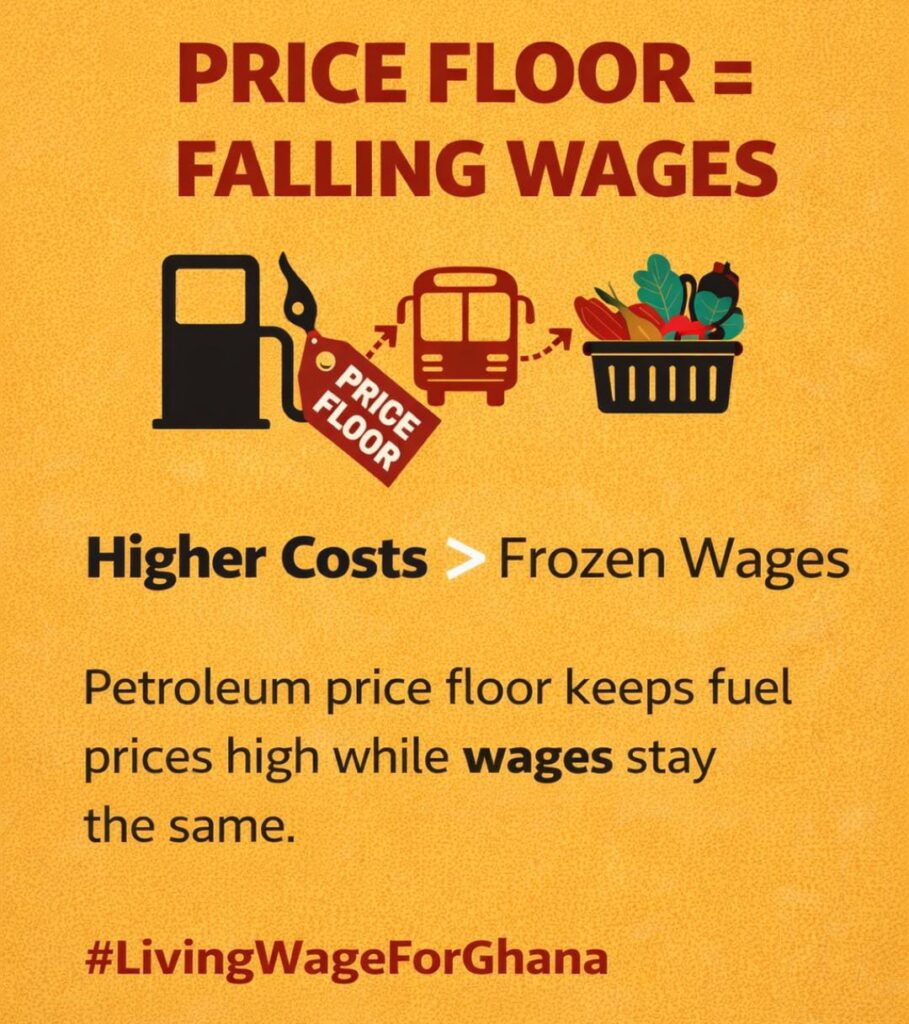
The introduction of a price floor in Ghana’s petroleum sector in 2024 has quietly but decisively undermined the real wages of Ghanaian workers. By preventing fuel prices from falling when market conditions permit, the policy has locked households into higher transport, food, and living costs without any corresponding adjustment in wages. In effect, the price floor operates as a policy-engineered wage cut, eroding purchasing power week after week while nominal wages remain frozen.
Fuel pricing, therefore, is not a peripheral market issue. It is a direct wage issue.
Analysis
Fuel prices behave differently from most prices in the economy. They adjust frequently and transmit rapidly into transport fares, food prices, and the cost of essential services. The introduction of a price floor has constrained downward price adjustments, reducing the scope and speed of pump-price relief even in periods when global prices or exchange-rate conditions would otherwise permit deeper reductions.
This asymmetry matters. In practice, price increases are transmitted quickly and fully, while price reductions are partial and delayed. Workers are therefore exposed to persistent cost pressures, even when macroeconomic conditions improve.
Ghana’s wage-setting framework is not designed to absorb this imbalance. The national daily minimum wage and public sector base pay are adjusted periodically, based on conditions prevailing at the time of negotiations. Fuel-driven costs, however, rise immediately and continuously. The result is structural: living costs move faster than wages, and real incomes decline.
This outcome is reinforced by the current minimum wage adjustment formula adopted last year. The formula explicitly accounts for:
– cost of living (indexed by inflation),
– productivity,
– ability to pay, and
– employment sustainability.
Crucially, cost of living is captured through inflation as a proxy. This methodological choice becomes problematic under a price-floor regime. When fuel prices are prevented from adjusting downward, transport and food costs remain elevated even when headline inflation moderates. Inflation therefore understates the lived cost pressures faced by workers, causing wage adjustments to lag behind reality.
In simple terms, the minimum wage formula may be functioning as designed, but the price floor distorts the signal it relies on. Wages are adjusted using inflation data that no longer fully reflects household survival costs. The consequence is predictable: negotiated wage increases are quickly neutralised by fuel-driven expenses.
This distortion spills directly into base pay negotiations between Government and Organised Labour. Elevated fuel costs raise fiscal pressures, which are then cited to restrain wage adjustments. Workers thus bear a double burden higher living costs created upstream by pricing policy, and constrained wage outcomes downstream in negotiations.
Conclusion
The petroleum price floor has demonstrated that fuel pricing policy cannot be separated from wage outcomes. By constraining downward price movements, the policy sustains cost pressures that wages are structurally incapable of matching.
The debate on the price floor must therefore move beyond competition and market structure to confront its real wage effects. A wage increase that is calibrated to inflation, but eroded by fuel-driven living costs, is not a wage increase at all.
If Ghana is serious about protecting workers’ purchasing power, industrial peace, and the credibility of wage governance, then fuel pricing policy must be evaluated through its impact on real wages, not just its effect on market stability.
A policy that raises costs automatically while wages adjust slowly is not neutral. It is redistributive and the redistribution is away from workers.
Kenneth Kobina KOOMSON