
Ghana has a long history of negotiating the National Minimum Wage through tripartite engagement among Government, Employers and Organised Labour. That history reflects an important national commitment; that wages at the bottom of the labour market should not be left entirely to the forces of bargaining power, employer discretion, or economic desperation.
Yet, after decades of minimum wage negotiations, annual communiqués and percentage adjustments, one uncomfortable reality remains, and that is, the national minimum wage still falls far below the real cost of living for many workers and their families.
That contradiction should concern every serious policymaker, employer and trade unionist. If the minimum wage is reviewed regularly but still cannot reasonably sustain the worker, then the problem is not only the final figure announced each year. The problem may also lie in the method used to determine it.
This is why Ghana must now ask a more fundamental question, are we truly determining a minimum wage, or are we merely adjusting an inadequate wage year after year?
A minimum wage formula that does not begin with the worker’s actual cost of living may produce technical outcomes, but it cannot produce wage justice. It may satisfy the arithmetic of negotiation, but fail the lived reality of the worker.
It is important we recongnise that, minimum wage did not emerge as a gift from employers or as a favour from the State. It emerged from the long history of labour struggle against exploitation, poverty wages, excessive working hours, and the treatment of labour as a mere commodity. Across the world, minimum wage regulation became necessary because the labour market, left entirely to itself, did not always produce justice.
The minimum wage is therefore not merely an economic number. It is a social justice instrument. It represents the point at which the State declares that work must not become a pathway to destitution. It is the lowest legal expression of the principle that labour is human, workers have families, and wages must sustain life.
Ghana’s national minimum wage must be understood within this historical and legal context. It is not an ordinary wage bargain between one employer and one group of workers. It is the legally recognised wage floor below which no worker should fall. Its purpose is protective: to prevent wages from sinking below a level that offends basic human dignity.
This is why ILO Convention No. 131 on Minimum Wage Fixing must guide Ghana’s approach. The Convention does not prescribe a rigid mathematical formula. Rather, it establishes a balancing framework. It requires minimum wage fixing to take into account the needs of workers and their families, the general level of wages in the country, the cost of living, social security benefits, the relative living standards of other social groups, and economic factors including productivity, economic development and the desirability of maintaining high employment.
The implication is important. Convention No. 131 does not support a minimum wage framework that treats workers’ needs as an afterthought. It requires balance, but balance does not mean beginning with the employer’s capacity and then fitting the worker’s life into what remains. It means first recognising the human purpose of the minimum wage, and then weighing that purpose against relevant economic realities.
Ghana’s current framework is generally understood to rely on four broad variables: inflation, productivity, ability to pay, and employment sustainability. On the surface, these variables appear balanced, technical and economically prudent. They seem to accommodate workers, employers, government and the wider economy.
But a more careful examination raises serious questions.
Are these variables clearly defined? Are they scientifically measured? Are the data sources transparent? Are the variables properly weighted? And, most importantly, do they begin from the actual needs of workers and their families?
These questions matter because minimum wage determination should not be reduced to an exercise in economic convenience. It should begin with a basic but profound question:
What does it actually cost a worker and the worker’s family to live?
Inflation is relevant because it measures the erosion of purchasing power. When prices rise and wages remain unchanged, workers become poorer in real terms. But inflation has a serious limitation: it does not tell us whether the existing wage was adequate in the first place.
If a worker is already earning below survival level, an inflation-based adjustment merely updates poverty. It does not correct it. Inflation can protect purchasing power, but it cannot establish wage adequacy.
Productivity is also legitimate in principle. Workers should share in productivity gains. But the question is: what productivity? Is it national productivity, labour productivity, sectoral productivity, enterprise productivity, GDP per worker, output per hour, value added per employee, or some other measure?
Unless Ghana clearly defines the productivity indicator being used, the institution producing it, the data source, the period covered, the method of computation and the weight assigned to it, productivity remains a slogan rather than a scientific determinant.
There is also a fairness problem. Productivity does not depend on labour alone. It depends on capital investment, technology, management systems, energy reliability, infrastructure, logistics, training, access to credit and industrial policy. If productivity is low because employers have failed to invest, or because the wider economy is inefficient, the worker’s minimum wage should not suffer for failures beyond labour’s control.
Ability to pay also sounds reasonable. No responsible wage policy should be completely blind to the state of the economy or the capacity of enterprises. But the phrase raises a fundamental question: whose ability to pay?
Is it government’s ability to pay? Is it the ability of large employers? Small businesses? Multinational companies? Distressed firms? Informal operators? If the national wage floor is determined by the weakest employer’s capacity, then the entire labour market is dragged down to the level of the least capable enterprise. That is not wage protection. It is wage depression.
Employment sustainability is equally important. But again, we must ask: what exactly are we sustaining? Decent employment or poverty employment? A job that pays below the cost of basic survival may count as employment statistically, but it is not decent work in any meaningful sense. There is no virtue in sustaining jobs that cannot sustain the worker.
The burden of employment sustainability cannot be placed mainly on the lowest-paid worker. Sustainable employment requires more than wage restraint. It requires industrial policy, productivity-enhancing investment, stable energy, affordable credit, fair taxation, infrastructure, skills development and stronger labour market institutions.
The deepest weakness of the current framework is that it does not begin with the worker. It begins with economic variables. But under the ILO framework, the needs of workers and their families are not decorative. They are central.
A credible minimum wage framework should therefore begin with a realistic worker-needs benchmark. That benchmark should include, at minimum, food, rent or accommodation, transport, utilities, health care, clothing, communication, family responsibilities, social protection gaps and a modest provision for emergencies.
A recent illustrative micro-basket from a worker living around the Ashaiman/Tema area showed that rent, utilities, transport and food alone could amount to approximately GH¢1,720 per month. This figure excludes medical care, clothing, communication, dependants, savings, emergencies, rent advance and other unavoidable social obligations.
This Ashaiman/Tema example is not presented as a national cost-of-living survey. It is used only to demonstrate the methodological point: minimum wage determination must be grounded in real expenditure.
A more defensible framework may therefore be expressed as follows:
National Minimum Wage = Cost-of-Living Basket + Decent Living Margin + Inflation Adjustment + Verified Productivity Share
In practical terms:
NMW = CLB + DLM + IA + VPS
Where:
NMW means National Minimum Wage.
CLB means Cost-of-Living Basket.
DLM means Decent Living Margin.
IA means Inflation Adjustment.
VPS means Verified Productivity Share.
The Cost-of-Living Basket should capture essential expenditure. The Decent Living Margin should provide a modest cushion for emergencies and basic resilience. Inflation should protect purchasing power. Verified productivity gains should allow workers to share in genuine economic improvement.
Ability to pay and employment sustainability should then guide implementation. They should not determine the dignity floor.
This distinction is critical. If the worker-needs benchmark shows that a worker requires a certain minimum amount to live, ability to pay should not be used to reduce that amount below survival level. Instead, it should guide phased implementation, tax support for vulnerable enterprises, productivity-enhancing measures, compliance strategy and sector-sensitive policy interventions.
In short:
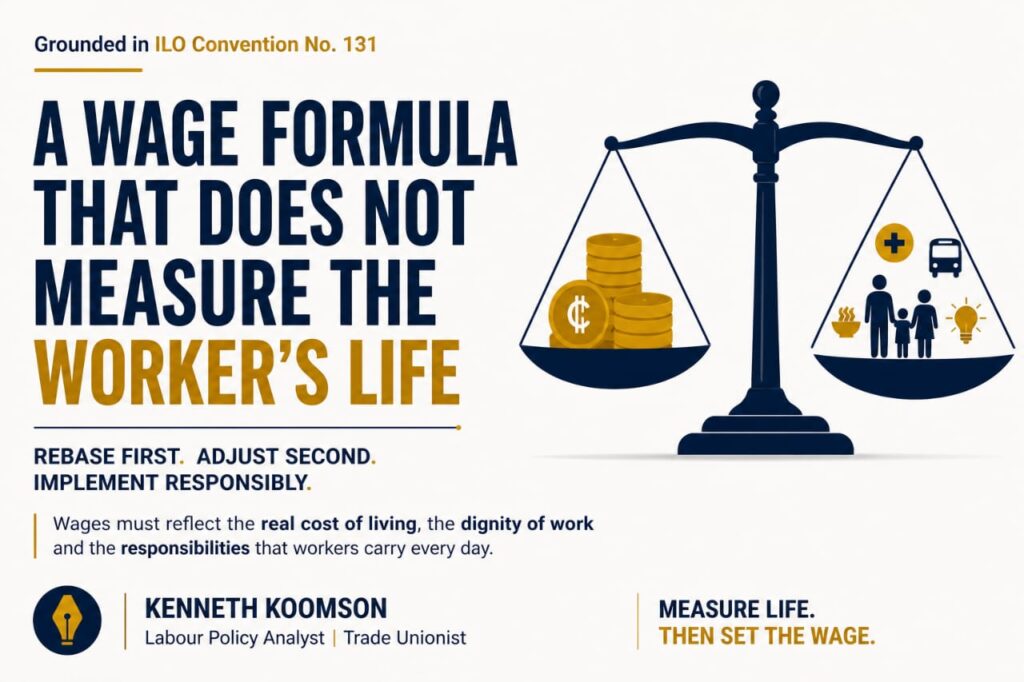
Rebase first. Adjust second. Implement responsibly.
Ghana’s current minimum wage framework is not useless, but it is structurally incomplete. Inflation is useful for adjustment, but weak as a foundation. Productivity is questionable unless clearly defined and reliably measured. Ability to pay is dangerous unless we know whose ability is being assessed. Employment sustainability is incomplete unless it distinguishes decent employment from poverty employment.
Together, these variables may produce a negotiated figure. But without a worker-needs benchmark, they cannot produce a just wage.
A national minimum wage should not be determined mainly by what employers say they can afford, what undefined productivity permits, or what broad employment arguments suggest. It must begin with what the worker requires to live.
A wage formula that does not measure food, rent, transport, utilities, health care, clothing, communication, family responsibility and basic dignity cannot honestly claim to determine a reasonable wage.
A wage formula that does not measure the worker’s life cannot honestly determine the worker’s wage.
Kenneth K. Koomson
IR, BSc HRM, LLB, LLM-ADR
Trade Unionist and Labour Policy Analyst