
Introduction
The right to strike occupies a central place in labour relations. It is one of the principal means by which workers and their organizations may, in lawful circumstances, defend their economic and social interests.
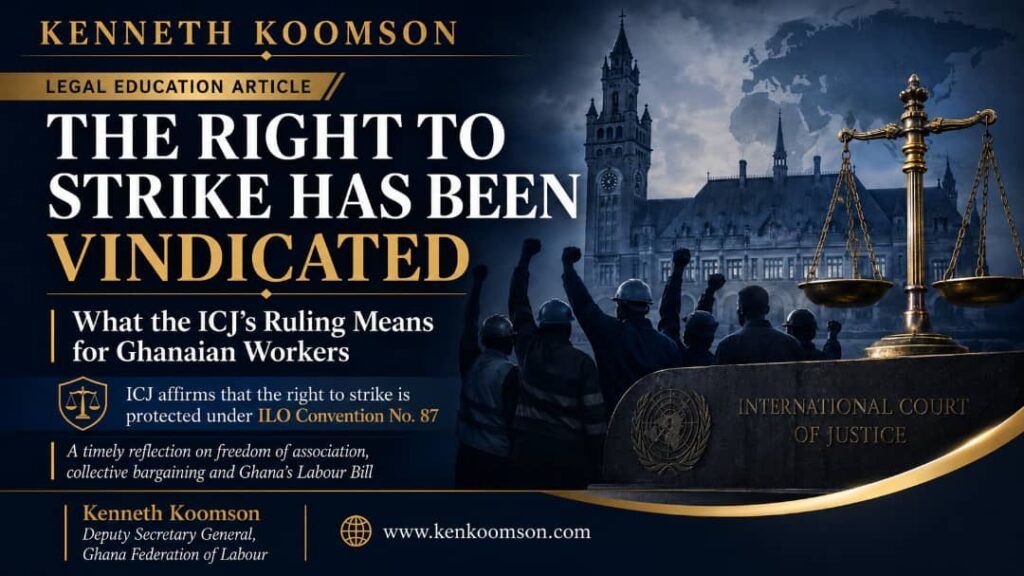
On 21 May 2026, the International Court of Justice delivered a historic Advisory Opinion on whether the right to strike is protected under the Freedom of Association and Protection of the Right to Organise Convention, 1948 (No. 87). By ten votes to four, the Court affirmed that the right to strike of workers and their organizations is protected under Convention No. 87.
This is a major development for international labour law, the global trade union movement, and Ghana’s labour law reform process. For Ghanaian workers and trade unions, the ruling must not be treated as a distant international event. It must become a central reference point in the ongoing discussion on the proposed Labour Bill.
Background to the International Dispute
The matter reached the International Court of Justice because of a long-standing disagreement within the International Labour Organization on whether Convention No. 87 protects the right to strike.
In November 2023, the Governing Body of the ILO referred the question to the International Court of Justice. The Governing Body recorded that there was a serious and persistent disagreement within the ILO’s tripartite constituency on the interpretation of Convention No. 87 with respect to the right to strike. It also recalled that the dispute arose from disagreement among the Organization’s tripartite constituents concerning whether the right to strike is protected under Convention No. 87.
The ILO Governing Body further noted that ILO supervisory bodies had consistently observed that the right to strike is a corollary of the fundamental right to freedom of association.
In legal reasoning, a corollary is a conclusion or principle that follows naturally from another established principle. The argument is therefore clear: if workers have the right to form and join organizations for the protection of their interests, those organizations must also have effective means to pursue those interests. The right to strike is one such means.
The Question Before the Court
The question referred to the International Court of Justice was direct and far-reaching:
“Is the right to strike of workers and their organizations protected under the Freedom of Association and Protection of the Right to Organise Convention, 1948 (No. 87)?”
The Court has now answered that question in the affirmative. In its Advisory Opinion, the Court found that it had jurisdiction, decided to comply with the request for an advisory opinion, and held by ten votes to four that the right to strike of workers and their organizations is protected under Convention No. 87.
That finding is historic. It settles, at the highest level of international judicial authority, that the right to strike is protected under one of the most important freedom of association instruments in international labour law.
Why the Ruling Matters
The significance of the ruling lies in the fact that freedom of association cannot be reduced to the mere right to form or join a trade union.
A trade union must be able to organize, represent, bargain, engage in social dialogue, and, where necessary and lawful, apply collective pressure in defence of workers’ interests. Without the right to strike, freedom of association risks becoming formal rather than effective.
Workers may have unions in name, but those unions may lack the practical power to act where negotiation fails, where employers refuse to bargain meaningfully, or where workers’ legitimate concerns are ignored.
The ICJ’s Advisory Opinion therefore strengthens the principle that freedom of association must be real, practical, and capable of protecting workers in actual industrial relations situations.
Ghana’s Current Labour Law Position
Ghana’s Labour Act, 2003, Act 651, recognizes strikes and lockouts, but regulates them within the framework of industrial dispute settlement.
Under Act 651, industrial action is not treated as an unrestricted right. Parties are generally required to comply with statutory dispute-resolution processes before resorting to strike or lockout action. These processes include negotiation, mediation, arbitration, and the dispute-resolution functions of the National Labour Commission.
This means Ghanaian law does not deny the right to strike. Rather, it regulates how and when the right may be exercised.
The Act also provides protection for lawful industrial action. Where a strike is lawful, the employment relationship should not be treated as terminated merely because a worker has participated in that strike. The law therefore recognizes that lawful strike action forms part of regulated industrial relations.
However, the limitation in the current framework is that the right to strike appears mainly as part of the machinery for resolving industrial disputes. It is less clearly stated as a substantive incident of freedom of association and collective bargaining.
That distinction matters.
If the right to strike is treated only as a procedural consequence of failed dispute resolution, it may be interpreted narrowly. But if it is understood as part of freedom of association, then the law must protect not only the steps leading to a strike, but also the broader autonomy of trade unions to represent workers, bargain collectively, and act effectively in defence of workers’ interests.
Why the Labour Bill Must Reflect the ICJ Advisory Opinion
The ICJ Advisory Opinion comes at a critical time, as Ghana considers reforms to its labour legislation.
The proposed Labour Bill must not merely reproduce the existing provisions of Act 651 on strikes and lockouts. It must take account of the ICJ’s authoritative clarification that the right to strike is protected under Convention No. 87.
This is where Organised Labour must be firm.
Organised Labour should insist that the principles affirmed by the ICJ are fully reflected in the proposed Labour Bill. The right to strike should not be treated merely as an administrative step within dispute settlement. It should be properly situated within the broader framework of freedom of association, collective bargaining, social dialogue, and sound industrial relations practice.
This does not mean that strikes should be unregulated. No serious labour movement argues for disorderly or unlawful industrial action. The issue is different. The law may regulate the exercise of the right to strike, but it must not regulate it in a manner that empties the right of practical value.
A right that exists only on paper, but is surrounded by excessive procedural barriers, weak protection against victimization, or overbroad restrictions, is not a meaningful right.
What Organised Labour Should Insist On
Organised Labour should insist that the proposed Labour Bill reflects the ICJ Advisory Opinion in at least five important respects.
First, the Bill should clearly recognize the right to strike as part of Ghana’s labour relations framework. The objective should not be to present strike action as unrestricted, but to ensure that lawful industrial action is properly understood as part of democratic labour relations.
Second, the Bill should reflect the connection between the right to strike, freedom of association, and collective bargaining. Following the ICJ’s Advisory Opinion, the right to strike should not be viewed only as the final stage of dispute settlement. It must also be understood as connected to the broader ability of trade unions to organize, represent, bargain, and act collectively in defence of workers.
Third, the Bill should strengthen protection against victimization where workers participate in lawful industrial action. A right that can easily be punished is not a meaningful right. Workers should not be dismissed, discriminated against, intimidated, transferred, demoted, or otherwise penalized merely because they participated in lawful strike action.
Fourth, strike procedures should remain reasonable and proportionate. Orderly industrial relations require clear procedures, notice requirements, dispute-resolution steps, and institutional safeguards. However, procedural requirements should not be so technical, excessive, or burdensome that they defeat the effective exercise of the right.
Fifth, the Bill should carefully review the treatment of essential services. Not every inconvenience to the public should be classified as an essential service. Where strike action is restricted in genuinely essential services, workers must have access to credible alternative dispute-resolution mechanisms, including independent, timely, and binding arbitration.
A Strategic Moment for Organised Labour
This is a strategic moment for Organised Labour in Ghana.
The ICJ Advisory Opinion provides legal and moral authority for unions to engage Government, employers, Parliament, labour administrators, and the National Labour Commission on the future of strike regulation in Ghana.
Organised Labour should therefore approach the Labour Bill process with one clear position: Ghana’s new labour law must not weaken the right to strike. It must regulate the right responsibly, but it must also protect it effectively.
The point must be made clearly: industrial peace is not achieved by weakening workers’ rights. Durable industrial peace is achieved when the law protects fair bargaining, social dialogue, institutional trust, and effective remedies for workers.
A labour law that recognizes trade unions but disables their ability to act collectively would reduce freedom of association to a formality. That is precisely what the ICJ Advisory Opinion helps to prevent.
Practical Lessons for Trade Unions
The ICJ Advisory Opinion is a victory for workers, but it is also a reminder of responsibility.
Trade unions must continue to educate members on the lawful procedures governing industrial action. The right to strike must be exercised with discipline, strategy, and proper institutional authority. Unions should also strengthen internal documentation before any industrial action is contemplated. The history of engagement, unresolved issues, notices, minutes, correspondence, and decisions of union organs must be properly recorded.
The legitimacy of strike action depends not only on the existence of the right, but also on how responsibly the right is exercised.
The stronger the legal discipline of unions, the stronger their moral and institutional authority when they resort to industrial action.
Conclusion
The ICJ’s Advisory Opinion is a historic affirmation of the right to strike as part of the protection guaranteed under ILO Convention No. 87.
For workers and trade unions, the ruling confirms that freedom of association is not empty symbolism. It must carry practical meaning. It must include the ability of workers’ organizations to act collectively in defence of workers’ rights and interests.
For Ghana, the ruling is timely. As the country considers a new Labour Bill, Organised Labour must insist that the Advisory Opinion is fully reflected in the reform process. The new law must balance industrial peace with effective freedom of association. It must regulate strikes, but it must not weaken the right beyond practical usefulness.
The right to strike has been vindicated. The next task is to ensure that this vindication is not left in The Hague, but carried into Ghana’s labour law, Ghana’s labour institutions, and Ghana’s workplaces.
About the Author
Kenneth Koomson is Deputy Secretary General of the Ghana Federation of Labour, a Chevening Scholar and IVLP Awardee. He holds a BSc in Human Resource Management, an LLB, and an LLM in Alternative Dispute Resolution. He writes on labour law, industrial relations, collective bargaining, social dialogue and workers’ rights.